

When a King Silenced Blue: The Obsession That Erased a World
- Laura Morini

- Dec 9, 2025
- 9 min read
Updated: Jul 20

The Color That Betrayed a King
King Edric Thornvale first saw the brilliance of blue when Lady Isolde Veyra entered the grand hall at Thornvale Castle. Her gown glimmered like a fragment of the sky, a shade so vivid it seared itself into Edric’s memory. He had long admired Isolde from afar, but the sight of her wearing the color, smiling at another suitor, felt like a betrayal that pierced his very soul. That single vision transformed fascination into obsession. From that day, blue became a symbol of heartbreak, of beauty turned cruel.
The court whispered of Edric’s strange melancholy, how his eyes would linger on any trace of azure in tapestries, garments, or murals. Even the smallest accents of the hue ignited a storm within him. Scholars and advisors attempted to counsel patience, to remind him that a single color could not be the measure of loyalty or love, yet Edric’s mind had already drawn the line. He began to imagine a world cleansed of the hue that had wounded him.
Princess Liora, his daughter, watched her father’s transformation with growing unease. She saw the once-gentle king spiral into a cold, meticulous obsession. The castle’s halls became eerily devoid of blue, a ghost of vibrancy erased by royal decree. Edric’s fixation grew not just personal but ideological. If blue represented betrayal, its eradication became a moral crusade.
By the time Edric retired to his private chambers at night, the king’s mind replayed the moment endlessly, the brilliance of Isolde’s gown haunting him, pushing him toward a radical decision that would forever alter Thornvale. The seeds of obsession had taken root, destined to spread beyond the borders of his kingdom.
Princess Liora whispered to herself in the shadows, fearing the future, and praying her father’s sorrow would not consume the world beyond Thornvale’s walls.

The First Decree
Edric Thornvale rose early one morning, a cold determination in his eyes. He called the council to the great hall, his voice ringing through the cavernous space as he issued an edict that would reshape the kingdom forever. Blue, in any form, would no longer be permitted. It was not a whim but a solemn duty, a cleansing of the betrayal he had endured. Tapestries were rolled and removed, murals repainted, and garments dyed into safer, muted shades. Even the banners that had flown proudly over the castle walls were replaced with colors deemed loyal and harmless.
Artisans, tailors, and architects obeyed, trembling as they altered their creations. Painful whispers filled the corridors of Thornvale as the kingdom adjusted to this absence. Some questioned the necessity, while others feared the king’s obsession and silently complied. The market squares, once vibrant with colorful fabrics, became subdued and monochrome. Children no longer played with blue-painted toys, and scribes erased azure ink from manuscripts, leaving blank spaces where beauty once had resided.
Princess Liora protested privately, her heart heavy as she watched the life of the kingdom dim. She pleaded with her father, speaking of the joy color brings, of its ability to inspire and comfort. Edric listened but saw only betrayal in her words. To him, even her objections felt like a reminder of Isolde’s affront, and he hardened his resolve.
By the end of the month, Thornvale had become a kingdom of muted greys, whites, and golds. The vibrancy that had once defined it was gone, replaced by a cold uniformity. Edric believed he was protecting his heart, yet in truth, he had begun a slow erasure of joy itself.
Liora wandered the quiet streets, hoping to find a fragment of color left behind, a spark to rekindle her father’s humanity before the kingdom became entirely hollow.
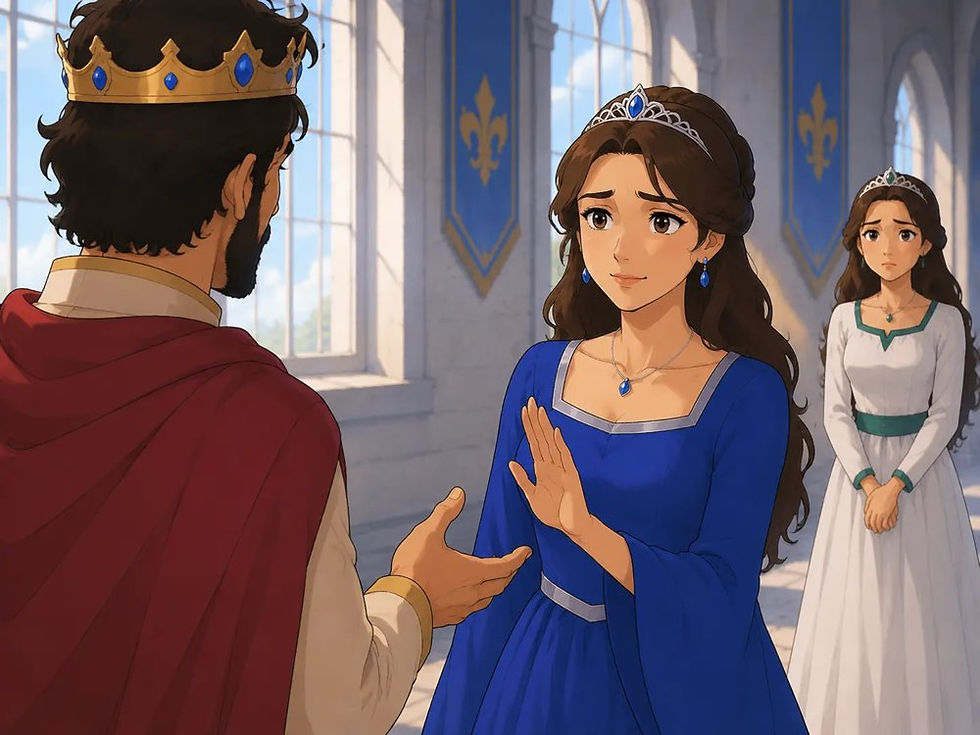
The Lady Who Started It All
Lady Isolde Veyra had once been the light of Edric Thornvale’s life. Her laughter filled the castle halls, and her presence brought warmth even to the coldest days of winter. She wore a gown of brilliant blue on the day that would forever scar Edric, a color that seemed to glow against her pale skin and dark hair. In that moment, what should have been admiration twisted into a piercing sting of rejection. She denied his proposal, smiling gently yet firmly, leaving him with a memory etched in every hue of that luminous fabric.
The king’s mind returned obsessively to the blue gown, replaying the scene with relentless precision. Psychologists centuries later might have called it trauma fixation, but in Edric’s time it became a driving force. Lady Isolde did not intend cruelty; she acted with the grace of her station, but Edric could see only betrayal. Every time he glimpsed blue, whether in the sky, a river, or a child’s toy, it brought back that moment, and the pain surged anew.
Liora, his daughter, understood some of her father’s inner torment, yet she could not convince him that his obsession had moved far beyond reason. The council whispered about his mental state, and the court artists and scholars feared the man who ruled with such a fractured heart.
Isolde had vanished from Thornvale shortly after the rejection, marrying a distant lord and leaving no trace of blue behind. Yet in Edric’s mind, she lingered as both muse and tormentor, the catalyst for the crusade that would erase color from the world. Every action he took was a shadow of that day, a desperate attempt to control the uncontrollable.
Princess Liora often wondered if her father loved Isolde still, or if he loved only the pain she had left behind. In that question lay the seeds of all the wars to come.

The War of Verdantia
King Alaric of Verdantia was a ruler known for his calm diplomacy, yet when Edric Thornvale’s armies appeared at the border, the blue banners of Verdantia flew defiantly, a silent challenge to Thornvale’s obsession. Alaric refused to erase the color from his cities, declaring that tradition and heritage could not be bent to a single man’s grief. The defiance enraged Edric, and his forces moved with relentless precision, the clang of armor and the roar of warhorses echoing through the valley.
Edric’s strategies combined ruthless cunning with calculated deception. Scouts reported on Verdantia’s defenses while spies infiltrated the courts, whispering lies to sow doubt among generals. Edric struck in the dead of night, sending battalions along hidden paths to surround Verdantia’s fortresses. The towns fell one by one, their blue banners torn down or burned, leaving a muted gray landscape where the color of tradition once reigned.
Amid the chaos, Princess Liora watched from Thornvale’s war tent, heart heavy with guilt. She saw the faces of soldiers and civilians alike, and wondered if her father’s victory would bring satisfaction or simply deepen the hollow obsession that consumed him. The streets of Verdantia ran quiet after the battle, and only the tolling of distant bells marked the sorrow of a kingdom forced into compliance.
King Alaric himself was captured, his defiance silenced by Edric’s relentless campaign. He knelt before Thornvale, a king unbroken in spirit but powerless to preserve the hues of his land.
By the time Edric returned to Thornvale, the second kingdom had surrendered, and blue was erased from its walls, clothing, and art. Liora saw her father’s eyes, triumphant yet haunted, and feared that no conquest could satisfy the man driven by a single memory.
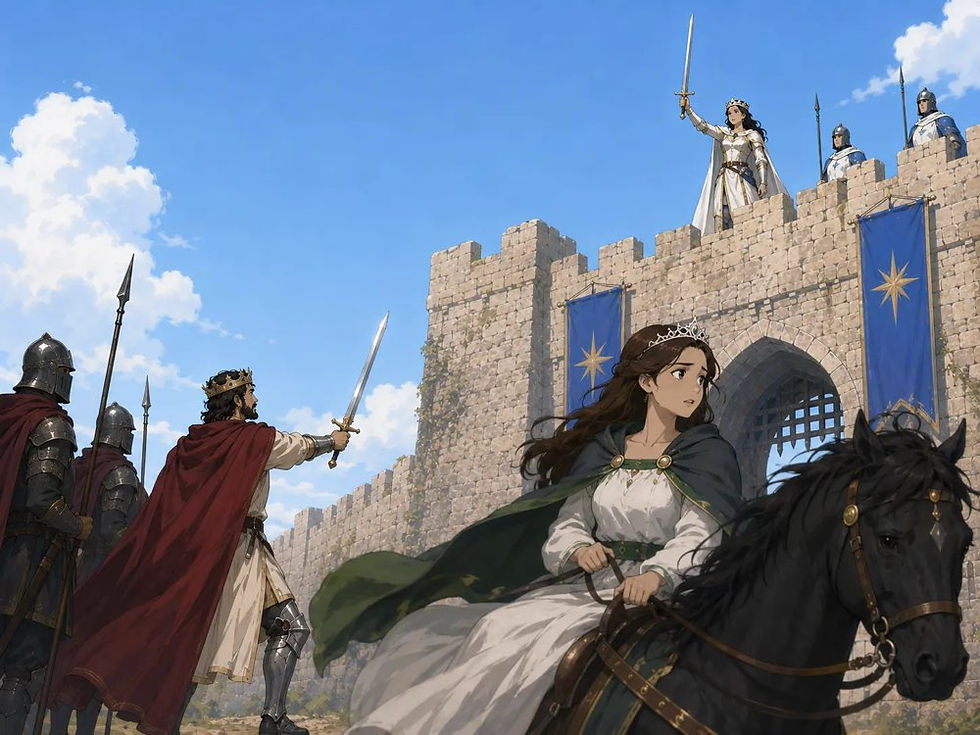
The Siege of Solara
Queen Selene of Solara was famed for her sharp mind and unwavering resolve. When Edric’s armies approached her sunlit city, the people of Solara lined the walls, blue fabrics streaming in the wind as a defiant symbol of their heritage. Selene refused to yield, knowing that bending to Thornvale’s obsession would erase centuries of culture. She met with her generals, plotting ambushes along the narrow mountain passes and ordering watchfires to confuse the enemy under cover of darkness.
Edric, however, moved with precision and a single-minded fury that made even seasoned soldiers uneasy. His siege engines battered Solara’s gates while infantry units flanked from hidden valleys. Archers rained down fire from cliff tops, and smoke filled the city streets, choking the citizens into submission. Even Selene’s careful strategies struggled against the relentless march of Thornvale’s disciplined legions.
In the midst of the battle, Princess Liora rode through the city on a black mare, urging civilians to seek shelter while her father’s army pressed on. She glimpsed Selene rallying her guards, blue sashes waving like stubborn flags of defiance. But Edric had anticipated every move. By morning, the gates were breached, the walls scarred with fire, and the royal banners torn down. Blue was replaced with gray, the color of conquest and obsession.
Selene knelt before Edric, her diplomacy crushed beneath the weight of his wrath. Her eyes held fire, but her city had fallen, and she was forced to watch as the hue of her people’s pride was erased.
As Edric returned to Thornvale, victorious once more, Liora felt the chill of another kingdom lost, the echoes of blue now silenced under her father’s relentless crusade.

The Fall of Noxen
King Darius of Noxen was unlike the rulers Edric had faced before. He was cunning, unpredictable, and prided himself on reading his enemies before they could act. When Thornvale’s army approached, Darius avoided open battle, setting false trails, ambush points, and feigned retreats that lured Edric’s forces into difficult terrain. For the first time, Edric felt the thrill of a challenge that matched his obsession.
But Edric’s ego burned brighter than the mountain sun. He reveled in the idea that no king could outthink him. Using spies and subtle bribes, he infiltrated Noxen’s court, feeding Darius misinformation about the loyalty of his closest generals. Messages arrived in Darius’ hand that seemed to confirm betrayals and shifting allegiances. Slowly, the seeds of doubt sprouted, forcing the Noxen king to question every move.
Edric pressed on, striking at the moments of hesitation with relentless precision. Skirmishes erupted across the forests and hills, each battle carefully orchestrated to make Darius react predictably. By the time the main army crossed Noxen’s northern plains, the king was already cornered. His forces, fractured by mistrust and confusion, could not mount a united defense.
In a final display of psychological dominance, Edric sent a personal envoy to deliver a proposition of surrender framed as honor. Darius, exhausted and isolated, had no choice but to yield. The banners of Noxen were lowered, blue eliminated from walls and halls, and the echoes of the once-proud kingdom were silenced under Edric’s manipulative hand.
Princess Liora watched from afar, her father’s brilliance overshadowed by his obsession, recognizing that intellect twisted by ego could devastate even the strongest of kingdoms.

The Last Kingdom: Eryndor
Queen Maribel of Eryndor was a ruler forged from ideals and tempered with the wisdom of generations. Unlike those Edric had conquered before, she did not cower or falter. When Thornvale’s army crossed her borders, Maribel met them with both strategy and courage, rallying her people with unwavering resolve. Her soldiers, inspired by her conviction, turned every hill, river, and forest into a battlefield that tested Edric’s army at every turn.
Edric, fueled by obsession and rage, pressed forward with calculated fury. He struck with precision, but Maribel’s forces anticipated many of his moves, turning the land into a maze of traps and counterattacks. The clash between their forces was brutal, a violent dance of steel and strategy where neither side yielded. Maribel faced Edric directly on the battlefield, her blade meeting his with skill and determination. Every strike, parry, and maneuver tested his ego and his resolve.
But obsession can blind even the most brilliant mind. In a desperate gambit, Edric finally overpowered her. Maribel fell, her ideals extinguished in the dust of battle. Yet victory came at a steep cost. Edric, though triumphant, suffered a grievous wound, an arrow that pierced his side and shattered part of his armor. The searing pain was a stark reminder that his conquest had exacted a toll beyond the battlefield.
As Edric watched Eryndor’s banners fall and the color blue erased from its halls, his mind swirled with both triumph and the first whispers of doubt. Princess Liora, witnessing the destruction and loss, mourned the brilliance of her father’s mind now twisted into obsession. The last kingdom had fallen, but the victory left the world hollow and his soul scarred.

A Throne in Silence
Edric Thornvale returned to his kingdom, limping through streets stripped of the blue that once symbolized life and vibrancy. The walls, now pale and muted, echoed with the absence of color, a ghostly reminder of every conquest and decree. His army followed quietly, subdued by the hollowness of their victories, the thrill of triumph drowned in the void he had created.
Seated heavily on his throne, the injury from Eryndor a constant, burning reminder of the cost of obsession, Edric allowed himself a rare moment of reflection. Memories of Lady Isolde flashed before his eyes, the brilliant blue of her gown, the laughter of his daughter Liora pleading for mercy, the defiance of the rulers he had slain. Every triumph now felt empty, every kingdom conquered a monument to futility.
Princess Liora knelt beside him, silent tears tracing the lines of grief and understanding. She had watched her father’s mind twist with desire and wrath, transforming a world of color into a lifeless expanse. Edric’s eyes, once filled with fire and obsession, softened as he regarded his daughter and the barren halls around them. The weight of his crusade pressed down, heavier than any army or weapon.
In his final moments, Edric exhaled slowly, the echoes of his deeds settling into stillness. The throne felt cold beneath him, and the world he had fought so hard to control seemed to mourn with him. He passed quietly, leaving Princess Liora to face a kingdom stripped of beauty yet full of lessons learned from obsession, loss, and the fragile power of human desire.
The silence in Thornvale was profound, a testament to the cost of allowing obsession to dominate the soul.
About the Author
I am Laura Morini. I love exploring forgotten histories, curious mysteries, and the hidden wonders of our world. Through stories, I hope to spark your imagination and invite you to see the extraordinary in the everyday.
Having followed Edric’s journey through war, obsession, and loss, we see how unchecked desire can hollow even the greatest kingdoms. His story warns us of the costs of letting obsession dominate our lives.
Join the CogniVane community by signing up for our newsletter to explore more strange histories and curious tales. Share your reflections below, like the post, and continue the conversation with fellow readers.



A very nice tale
Obsession can really make anyone loose sight of what's right
Edirc allowed the pain of rejection to stir hatred in his heart, which caused him to act irrationally and which led to his end
"When a king silenced blue" is a enjoyable read.