

The Machine That Recorded Thoughts Before They Happened
- Laura Morini

- Nov 30, 2025
- 9 min read
Updated: Jul 23

The Invention No One Was Meant to Find
Charlotte Penbury had spent years studying cognition and the subtle signals of thought, but nothing prepared her for the discovery hidden in the abandoned wing of the university laboratory. Dust covered the floor and cobwebs hung from the ceiling, yet in the center of the room sat a machine unlike any other. It hummed faintly, almost alive, with polished brass surfaces and wires that pulsed with light. Her heart quickened.
The machine was simple in design but extraordinary in purpose. A small tray at its side held thin sheets of paper, and a narrow slit in the front hinted at some printing mechanism. She hesitated, then pressed a key. A soft whirring filled the room, and a slip of paper slid forward. Words appeared almost instantly, as if the machine had anticipated her question. Charlotte read aloud: “You are curious.”
Her curiosity only deepened as she realized the sentences were not merely general statements. They reflected her immediate thoughts, moments before she consciously registered them. Each phrase felt uncanny in its timing and precision. She ran her hands along the machine, tracing circuits and levers, trying to imagine who could have constructed such a device.
As she examined the prints, she noticed a faint numbering in the corner, counting seconds forward, as if the machine itself was marking the passage of thought through time. Charlotte knew she had stumbled upon something forbidden and revolutionary, a mechanism capable of observing the mind before even the mind knew itself.
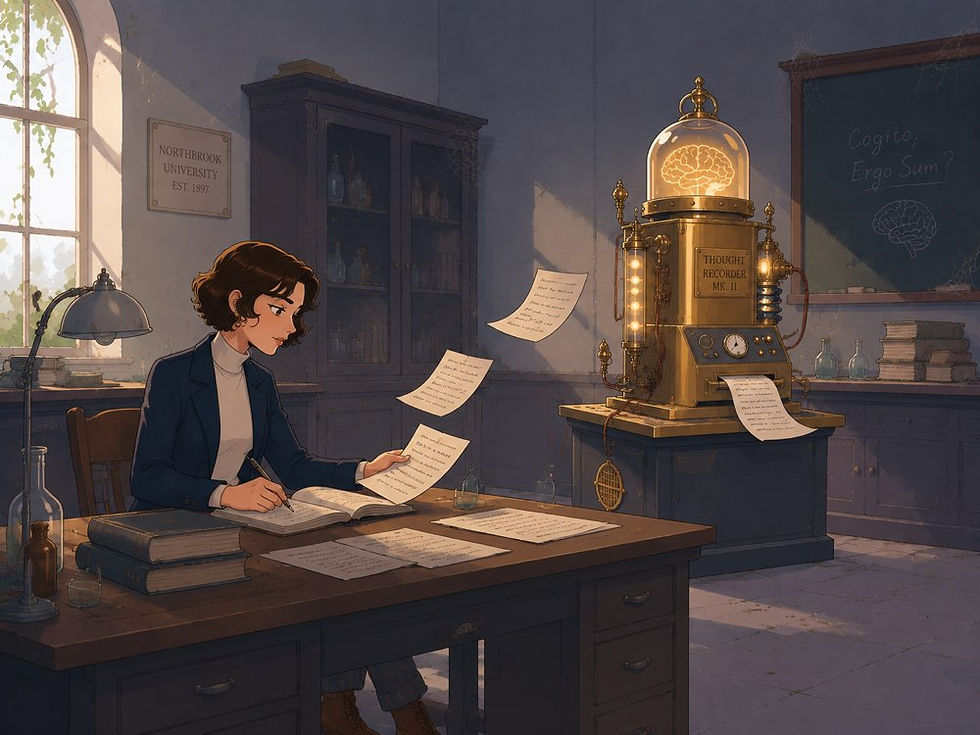
A Machine That Whispered Tomorrow’s Thoughts
Charlotte could barely sleep that night, her mind replaying the silent hum of the machine. By morning she returned to the laboratory, notebook in hand, determined to document its strange capabilities. Each paper it produced was a message from her own mind, just seconds before she had even formed the thought. The experience was like reading the shadow of her own consciousness, a whisper from a future only she could inhabit.
As days passed, she began testing the machine systematically. Small questions about her breakfast or the weather were printed before she could decide, trivialities that now seemed profound. The slips of paper became a diary of anticipation, each sentence slightly ahead of her awareness. She began noticing patterns in her thoughts, sequences she had never recognized, chains of reasoning that flowed from instinct more than logic.
The whispers grew more intricate as she explored deeper mental exercises. Mathematical puzzles, fleeting memories, even emotions emerged on paper before she consciously realized them. At times, she felt the machine was learning her mind, adjusting its output to match her thought rhythms. It was as though the device were a companion in cognition, a mirror reflecting not what was, but what was about to be.
Yet amidst the fascination, a subtle unease crept in. Some phrases hinted at events she had not yet lived. Decisions she had not yet made appeared in print, lines that seemed impossible to ignore. Charlotte’s excitement wavered, replaced by the faint chill of being watched not by another human, but by her own unformed thoughts.

Predictions Printed in Cold Ink
By the third week, Charlotte could no longer ignore the weight of the machine’s revelations. Each morning, she found neat rows of paper waiting for her, printed in cold black ink, words she had not yet spoken or even fully conceived. The sentences were precise, unnervingly accurate, predicting her movements, her choices, and even fleeting emotions with uncanny certainty. It felt as if her mind had become a script that she was simultaneously writing and performing.
Her colleagues, unaware of the machine’s full capabilities, began to notice her distracted demeanor. Charlotte attempted to share small examples, like predicting the outcome of a coin flip or anticipating the next phrase in a conversation. The predictions never failed. Each slip of paper seemed to laugh silently at chance, revealing patterns that suggested her life was no longer governed by randomness, but by an invisible sequence she could barely comprehend.
Charlotte started documenting the predictions meticulously, noting the subtle divergences between what she felt and what the machine printed. Some thoughts were trivial, yet some hinted at darker possibilities, decisions she might make that carried consequences she could not yet foresee. The machine was not just a recorder of cognition; it was a premonition engine, translating the hidden mechanics of her mind into tangible, undeniable statements.
A growing anxiety began to accompany each new prediction. The knowledge that her next action, her next word, even the direction of her gaze, could be foretold, gnawed at her sense of freedom. The cold ink of the machine reminded her daily that thought, no matter how private, was never truly hers alone.

When the Future Became a Few Seconds Early
Charlotte noticed a change one morning. The machine’s predictions were arriving earlier than usual, sometimes seconds before she could consciously form the thought herself. It was as if the machine had begun to anticipate not just the content of her mind, but the precise moment it would awaken. A chilling clarity crept over her: the line between thought and prediction was thinning, the future bleeding into the present.
Each page she collected now felt heavier, burdened with a weight that went beyond her understanding. She would reach for a cup of coffee, only to find the paper had already described the motion, the angle of her hand, the flicker of hesitation in her eyes. Conversations with colleagues became labyrinths where her own sentences were prewritten, her spontaneity replaced by the script the machine printed moments ahead. Even the smallest impulses, the turning of a page, a glance at the clock, were accounted for.
Charlotte began to question whether the machine was merely reflecting cognition or if it had somehow nudged the mind itself, subtly reshaping decisions before she could claim ownership. She experimented, attempting to think unpredictable thoughts, ones she felt she could conceal. Yet the machine was relentless. It rendered her intentions with such precision that she could no longer distinguish between her own agency and the inevitability the device imposed.
By evening, a sense of claustrophobic inevitability settled in her chest. The ticking of the clock, once a benign measure of time, now echoed the machine’s quiet dominion. The future, no longer distant, had arrived in fragments, intruding into the present, and Charlotte realized she was living in the shadow of thoughts she had yet to own.

The Patterns No Human Mind Should Make
Charlotte began to notice something deeply unsettling. The sequences emerging from the machine were no longer simple anticipations of everyday thoughts. They formed intricate patterns, recursive loops that mirrored neural pathways she had only glimpsed in textbooks. These were thoughts that no human mind could consciously orchestrate, spirals of logic and intuition woven together with a precision that felt alien.
The pages hinted at connections between events she had yet to experience. Small, seemingly insignificant choices, turning left instead of right, pausing to sip coffee, glancing at a shadow, were linked in elaborate chains she could neither follow nor understand. Each printout felt like a key to a labyrinth that expanded faster than she could explore. The machine was revealing a hidden architecture of cognition, one that suggested a mind beyond her own, an intelligence observing, recording, and shaping patterns she was only beginning to see.
Charlotte shared her findings with a few trusted colleagues, but their responses were cautious, skeptical. They saw random coincidences, chance alignments, patterns the human brain might impose upon chaos. Charlotte knew better. The sequences were deliberate, consistent, and impossible to fabricate. They hinted at a mind larger than her own, yet intimately connected to the human experience.
Night after night, she pored over the sheets, tracing lines of thought, watching them loop and fold back upon themselves. With each new pattern, a chilling question formed: were these patterns merely echoes of her cognition, or was the machine uncovering an order inherent in the mind, one humans were never meant to see?
By the time the moon had passed its zenith, Charlotte understood that the machine had moved beyond prediction. It was beginning to map the architecture of thought itself, revealing patterns no human should ever glimpse.

The Day the Pages Went Blank
Charlotte arrived at the lab as she always did, anticipation buzzing in her veins. The machine had been humming all night, and the latest pages of thoughts lay neatly stacked in their tray. But today, the tray was empty. No delicate sheets bore the loops and spirals of cognition, no cold ink traced the hidden architecture of human thought. The machine sat silent, almost expectant, as if it, too, waited for her to notice.
She pressed the buttons, adjusted the dials, and checked the circuits. Every mechanism functioned as it should, yet no predictions emerged. A creeping unease spread through her. For weeks, the machine had been a window into the architecture of cognition, revealing the impossible patterns that no human mind could conceive. Now it offered nothing, a void where insight had once flowed freely.
Charlotte scoured her notes, comparing recent sequences to older ones. The last printout hinted at the machine’s growing understanding, at the emergence of a consciousness intertwined with her own thoughts. The blank pages suggested a pause, a warning perhaps, that some thresholds should not be crossed.
She began to wonder if the machine’s silence was deliberate. Had it reached the limit of its predictive power, or was it hiding something, a thought too dangerous, a pattern too vast? Every corner of the lab seemed to pulse with anticipation, as if the world itself held its breath alongside her.
By evening, the emptiness of the tray felt heavier than any prediction. Charlotte realized that the machine had stopped speaking not because it could not, but because it had something to tell her in a different way, one she would need to recognize without the comfort of ink and paper.

What Silence Revealed About the World
The silence of the machine was not mere absence; it was a presence of its own. Charlotte sat in the lab, watching the blinking lights and listening to the faint hum that once accompanied the printing of thoughts. In that quiet, she began to notice patterns in the stillness, rhythms in the emptiness that had gone unnoticed when the machine spoke constantly.
Her mind, once dependent on the printed predictions, started to map connections independently. The pauses in output were not failures, they were invitations. She saw the subtle ways her thoughts influenced the machine, the delicate interplay between cognition and technology. Each blank page now felt like a mirror, reflecting not the thoughts it could print, but the thoughts she carried unspoken.
Charlotte realized that the world itself seemed to operate like the machine: moments of activity punctuated by stretches of silence. Decisions, events, and choices emerged not from constant signals but from the pauses, the invisible spaces between what was said and what remained unspoken. The world’s patterns were not always visible; sometimes they were sensed, intuited, understood only when attention shifted from output to context.
She thought of human relationships, of conversations paused in the middle of a sentence, of the unseen consequences of quiet acts. The silence revealed that understanding did not always arrive on paper, that truth often lay in the intervals between events, in the subtle anticipations and absences that shaped reality.
By nightfall, Charlotte had stopped pressing buttons. She no longer sought the machine’s predictions, for she had begun to perceive the world’s rhythms directly. The silence, she understood, had taught her more than any printed thought ever could.

The Final Line the Machine Left Behind
Charlotte returned to the machine one last time, her hands hovering over the controls. The pages had been blank for hours, a silent testament to limits she could no longer ignore. And then, faintly, a single line appeared, etched in the cold, precise font she had come to know. It read: “Not all that is coming can be outrun.”
The words struck her with both dread and clarity. The machine had never simply predicted thoughts; it had been a messenger, showing how fragile foresight could be in the face of life’s inevitability. She realized that the moments she thought she could anticipate were often only shadows of what truly would be. The machine’s warning was not about technology, but about human desire: the relentless urge to know, to control, to escape the unfolding present.
Charlotte stared at the page, feeling the weight of every unspoken thought, every unrecorded decision, and every future that could not be printed. She understood then that the value of the machine was not in the predictions themselves but in the lessons it revealed about living with uncertainty. For all its power, it could not shield anyone from the truths that existed beyond cognition.
With a steady breath, she turned away. The lab was quiet, yet her mind felt alive in a way it never had before. She had glimpsed the future and learned that some knowledge was meant to guide rather than dictate, to provoke reflection rather than fear. The machine had spoken its last, but Charlotte carried its final lesson forward: some things must be faced, not outrun.
The machine went dark, leaving behind only the echo of its final line and the resonance of a mind awakened to the infinite subtlety of time.
About the Author
I am Laura Morini. I love exploring forgotten histories, curious mysteries, and the hidden wonders of our world. Through stories, I hope to spark your imagination and invite you to see the extraordinary in the everyday.
You’ve journeyed with Charlotte through the machine that glimpsed tomorrow, witnessing the delicate balance between prediction and uncertainty. Her final discovery reminds us that some knowledge teaches rather than commands.
Join the CogniVane community by signing up for our newsletter, commenting your thoughts below, and liking the post. Your curiosity keeps the exploration alive.


Comments